
Canada Express Entry · Latest Draw Results
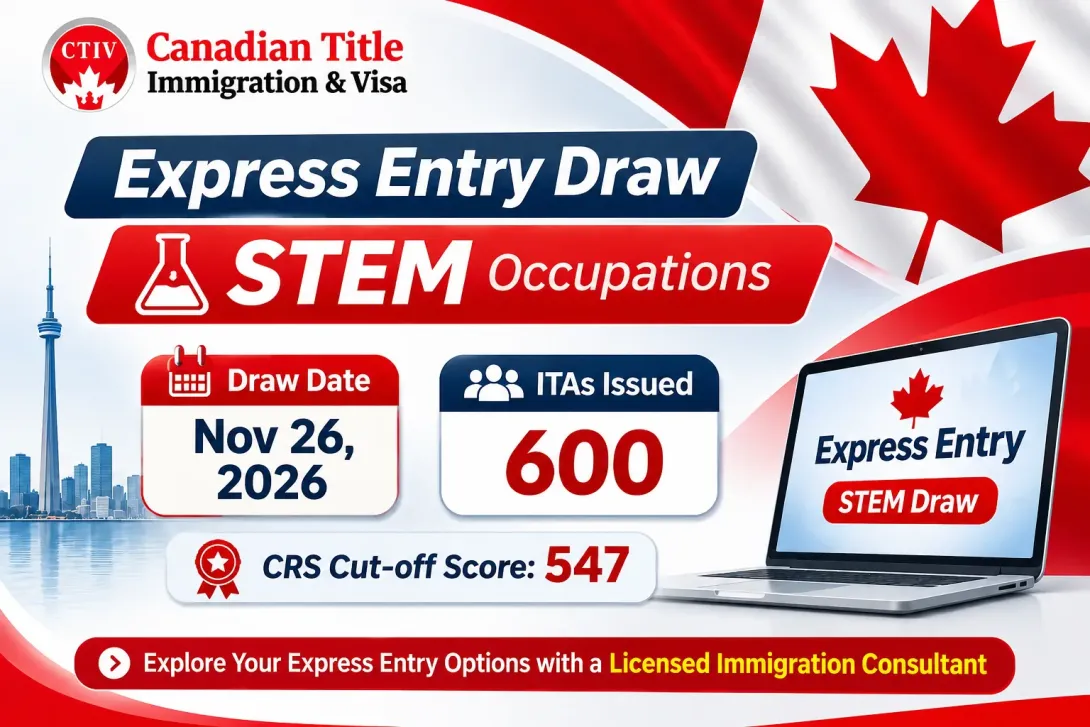
Express Entry Draw: 600 STEM Candidates Invited at CRS 547
Canada has held its first STEM-focused Express Entry selection in more than two and a half years. On November 26, 2026, Immigration, Refugees and Citizenship Canada (IRCC) invited 600 candidates to apply for permanent residence, with the lowest-ranked invited candidate recording a Comprehensive Ranking System (CRS) score of 547.
The latest round follows major changes to CRS points for eligible Canadian work experience and high-wage job offers that took effect earlier this month. These changes may influence how candidates assess their profiles and plan their next steps.
1. Details of the November 26, 2026 STEM draw
The latest selection focused on candidates whose occupations fall within the STEM category under Express Entry. STEM refers to science, technology, engineering and mathematics-related occupations.
| Draw date | November 26, 2026 |
|---|---|
| Draw category | STEM occupations |
| Invitations issued | 600 |
| Lowest CRS score invited | 547 |
| Tie-breaking date and time | December 2, 2025, at 4:52:51 p.m. UTC |
| Previous STEM draw | April 11, 2024 |
Who received an invitation?
To receive an invitation in this round, a candidate needed to:
- Have an eligible Express Entry profile in the pool.
- Meet the applicable STEM category requirements.
- Have a CRS score of at least 547.
- For candidates with exactly 547 points, have submitted their profile before the tie-breaking date and time specified by IRCC.
Being selected in a category-based draw does not remove the need to satisfy the relevant Express Entry program and application requirements. Candidates should confirm that their occupation and work experience meet the applicable category criteria.
2. How does this compare with the previous STEM draw?
The previous STEM-focused Express Entry round took place on April 11, 2024. That selection issued 4,500 invitations, with a minimum CRS score of 491.
| Measure | April 11, 2024 | November 26, 2026 |
|---|---|---|
| Invitations issued | 4,500 | 600 |
| CRS cut-off | 491 | 547 |
| Difference in invitations | — | 3,900 fewer |
| Difference in CRS score | — | 56 points higher |
The latest round was considerably smaller, and the CRS threshold was higher than in April 2024. However, the two rounds took place under different selection circumstances and should not be treated as a direct forecast of future STEM draws.
3. Express Entry draw history for 2026
The following table contains the draw dates, categories, CRS cut-off scores and invitation numbers supplied for the 2026 selection rounds. Use the search field to locate a draw category or date. You can also filter by category and sort each numerical column.
Select a column heading to sort ascending or descending. Use the search and category filter together to narrow the results.
Showing 68 draw records
| November 26 | STEM | 547 | 600 |
| November 25 | French-Language proficiency | 401 | 6,000 |
| November 23 | Provincial Nominee Program | 673 | 1,999 |
| October 28 | Transport | 477 | 150 |
| October 27 | French-Language proficiency | 407 | 5,000 |
| October 26 | Provincial Nominee Program | 761 | 792 |
| October 16 | French-Language proficiency | 435 | 5,000 |
| October 15 | Canadian Experience Class | 519 | 2,500 |
| October 13 | Provincial Nominee Program | 772 | 752 |
| October 1 | Trades | 476 | 3,500 |
| September 29 | Canadian Experience Class | 518 | 2,000 |
| September 28 | Provincial Nominee Program | 725 | 733 |
| September 16 | Senior Managers with Canadian Work Experience | 389 | 250 |
| September 15 | Canadian Experience Class | 519 | 2,000 |
| September 14 | Provincial Nominee Program | 734 | 576 |
| September 4 | Healthcare and social services | 475 | 3,500 |
| September 3 | Physicians with Canadian work experience | 198 | 229 |
| September 1 | Canadian Experience Class | 521 | 2,000 |
| August 31 | Provincial Nominee Program | 697 | 562 |
| August 19 | French-Language proficiency | 382 | 5,000 |
| August 18 | Canadian Experience Class | 523 | 1,000 |
| August 17 | Provincial Nominee Program | 760 | 442 |
| August 7 | Transport | 470 | 300 |
| August 6 | French-Language proficiency | 391 | 5,000 |
| August 5 | Canadian Experience Class | 516 | 3,000 |
| August 4 | Provincial Nominee Program | 768 | 507 |
| July 23 | Skilled Military Recruits | 368 | 4 |
| July 22 | French-Language proficiency | 399 | 5,000 |
| July 21 | Canadian Experience Class | 516 | 2,000 |
| July 20 | Provincial Nominee Program | 744 | 511 |
| July 10 | Senior Managers with Canadian Work Experience | 392 | 500 |
| July 9 | French-Language proficiency | 420 | 5,000 |
| July 7 | Canadian Experience Class | 517 | 2,000 |
| July 6 | Provincial Nominee Program | 708 | 534 |
| June 25 | Healthcare and social services | 475 | 4,000 |
| June 24 | Physicians with Canadian work experience | 223 | 271 |
| June 23 | Canadian Experience Class | 516 | 4,000 |
| June 22 | Provincial Nominee Program | 730 | 955 |
| May 28 | French-Language proficiency | 409 | 4,500 |
| May 27 | Canadian Experience Class | 518 | 3,000 |
| May 25 | Provincial Nominee Program | 805 | 334 |
| May 11 | Provincial Nominee Program | 798 | 380 |
| April 29 | French-Language proficiency | 400 | 4,000 |
| April 28 | Canadian Experience Class | 514 | 2,000 |
| April 27 | Provincial Nominee Program | 795 | 473 |
| April 15 | French-Language proficiency | 419 | 4,000 |
| April 14 | Canadian Experience Class | 515 | 2,000 |
| April 13 | Provincial Nominee Program | 786 | 324 |
| April 2 | Trades | 477 | 3,000 |
| March 31 | Canadian Experience Class | 509 | 2,250 |
| March 30 | Provincial Nominee Program | 802 | 356 |
| March 18 | French-Language proficiency | 393 | 4,000 |
| March 17 | Canadian Experience Class | 507 | 4,000 |
| March 16 | Provincial Nominee Program | 742 | 362 |
| March 5 | Senior Managers with Canadian Work Experience | 429 | 250 |
| March 4 | French-Language proficiency | 397 | 5,500 |
| March 3 | Canadian Experience Class | 508 | 4,000 |
| March 2 | Provincial Nominee Program | 710 | 264 |
| February 20 | Healthcare and social services | 467 | 4,000 |
| February 19 | Physicians with Canadian work experience | 169 | 391 |
| February 17 | Canadian Experience Class | 508 | 6,000 |
| February 16 | Provincial Nominee Program | 789 | 279 |
| February 6 | French-Language proficiency | 400 | 8,500 |
| February 3 | Provincial Nominee Program | 749 | 423 |
| January 21 | Canadian Experience Class | 509 | 6,000 |
| January 20 | Provincial Nominee Program | 746 | 681 |
| January 7 | Canadian Experience Class | 511 | 8,000 |
| January 5 | Provincial Nominee Program | 711 | 574 |
Source: draw records supplied for this article. Check the official IRCC rounds of invitations page for the latest updates and individual round details.
4. How frequently did IRCC hold each type of draw?
The 2026 draw mix shows that IRCC used several selection approaches. Provincial Nominee Program rounds were the most frequent, followed by Canadian Experience Class and French-language proficiency selections.
Number of draws by category
| Draw category | Number of draws |
|---|---|
| Provincial Nominee Program | 22 |
| Canadian Experience Class | 18 |
| French-Language proficiency | 13 |
| Physicians with Canadian work experience | 3 |
| Healthcare and social services | 3 |
| Senior Managers with Canadian Work Experience | 3 |
| Trades | 2 |
| Transport | 2 |
| Skilled Military Recruits | 1 |
| STEM | 1 |
| Total | 68 |
These figures describe the number of rounds in each category, not the number of people invited. A category with fewer draws may still issue a substantial number of invitations in a single round.
5. Where were the 2026 invitations allocated?
Based on the supplied annual figures, IRCC issued 158,008 invitations to apply through the listed Express Entry selection categories in 2026.
Invitations issued by draw category
| Draw category | ITAs issued |
|---|---|
| French-Language proficiency | 66,500 |
| Canadian Experience Class | 57,750 |
| Provincial Nominee Program | 12,813 |
| Healthcare and social services | 11,500 |
| Trades | 6,500 |
| Senior Managers with Canadian Work Experience | 1,000 |
| Physicians with Canadian work experience | 891 |
| STEM | 600 |
| Transport | 450 |
| Skilled Military Recruits | 4 |
| Total | 158,008 |
French-language proficiency and Canadian Experience Class selections account for the largest invitation totals in the figures supplied. Candidates should remember that the number of invitations in a category does not establish their personal eligibility or guarantee that a similar draw will take place again.
6. The new CRS rules introduced on November 3, 2026
One of the most significant recent Express Entry developments is the introduction of the Labour Market Integration factor. The revised system recognizes eligible Canadian work experience in high-wage occupations and qualifying job offers in eligible high-wage occupations.
The new factor compares the score available through eligible Canadian work experience with the score available through a qualifying job offer. A candidate receives the higher applicable score under this factor. The two routes cannot simply be added together.
What changed?
| Area | Previous approach | New approach from November 3 |
|---|---|---|
| Canadian work experience | Existing CRS points based on qualifying work duration | Additional high-wage occupation points may apply to eligible Canadian experience |
| Job offer points | Job offer CRS points had been removed in March 2025 | Qualifying high-wage job offers can receive 50, 70 or 100 points |
| LMIA for qualifying job offer points | Previous requirements applied | An LMIA is no longer required for the new qualifying high-wage job offer points, subject to the applicable rules |
| Federal Skilled Worker and Federal Skilled Trades eligibility | Previous LMIA-related requirements applied | A temporary public policy provides eligible exemptions for candidates invited on or after November 3, 2026 |
The change does not mean every Canadian job offer now receives CRS points. The occupation must be included in IRCC's eligible high-wage list, and the job offer must satisfy the applicable requirements.
IRCC continues to assess whether an offer is genuine, whether the employer has a real business need, whether the candidate can perform the work and whether applicable employment and recruitment rules have been followed.
7. How high-wage occupation points work
IRCC classifies high-wage occupations using the National Occupational Classification (NOC). The classification is based on the occupation's national median wage compared with the average median wage of the Canadian workforce. It is not determined simply by the salary an individual candidate receives.
Additional CRS points for eligible Canadian work experience
| Occupation level | National median wage threshold | Additional CRS points |
|---|---|---|
| Level 1 | At least 2 times the workforce median | 70 |
| Level 2 | At least 1.5 times but less than 2 times | 40 |
| Level 3 | At least 1.3 times but less than 1.5 times | 20 |
To receive these high-wage work-experience points, a candidate generally needs at least 12 months of eligible Canadian work experience in one or more qualifying occupations. The experience must also meet the existing Express Entry requirements.
Points for a qualifying high-wage job offer
| Occupation level | Job offer CRS points |
|---|---|
| At least 2 times the workforce median | 100 |
| At least 1.5 times but less than 2 times | 70 |
| At least 1.3 times but less than 1.5 times | 50 |
| Not on the eligible high-wage occupation list | 0 under this factor |
A qualifying job offer generally needs to be full-time, continuous and for at least one year after the candidate becomes a permanent resident, subject to the detailed requirements and exceptions in the Ministerial Instructions.
How the two scoring routes are compared
The Labour Market Integration factor is designed to compare the candidate's eligible Canadian work-experience score with their qualifying job-offer score. The higher applicable result is used.
Before relying on these points, candidates should verify their exact NOC code, eligible work experience, job offer details and the version of IRCC's high-wage occupation list that applies on the relevant invitation date.
Check the current list through IRCC's high-wage occupations page.
8. November 17 changes for university professors and researchers
IRCC introduced another adjustment on November 17, 2026, affecting university professors, lecturers and certain research-related work experience.
University professors and lecturers – NOC 41200
Eligible Canadian work experience and job offers for university professors and lecturers can now include non-wage compensation paid by a Canadian entity. This may include:
- Stipends
- Research grants
- Bursaries
- Scholarships
This adjustment recognizes that some academic and research roles are funded through arrangements other than conventional wages. Candidates must still meet the applicable program and occupational requirements.
Post-secondary teaching and research assistants – NOC 41201
IRCC also removed NOC 41201 from the Researchers with Canadian work experience category. Candidates working in these roles should not assume that their experience qualifies for that category merely because their work involves teaching or research at a post-secondary institution.
Review the updated requirements directly on IRCC's Express Entry changes page.
9. Bridging Open Work Permits for Express Entry applicants
Some foreign nationals already working in Canada may be eligible for a Bridging Open Work Permit (BOWP) after submitting a complete permanent residence application through Express Entry.
A BOWP is intended to help eligible applicants continue working in Canada while IRCC processes their permanent residence application. It is not available simply because someone has created an Express Entry profile or is waiting for an invitation.
Who may qualify?
For the usual Express Entry BOWP route, applicants generally need to:
- Be the principal applicant in the permanent residence application.
- Have submitted a complete PR application that passed the completeness check.
- Have received an acknowledgement of receipt (AOR) from IRCC.
- Be living in Canada and intend to reside outside Quebec when applying.
- Have valid temporary resident status and a work permit, maintained worker status, or meet the applicable restoration requirements.
- Meet the other program-specific requirements for the BOWP.
Can you continue working while waiting?
If an eligible worker submits a work permit extension application before their existing work permit expires and remains in Canada, they may benefit from maintained status. Where authorized, they can continue working under the same conditions as their previous permit while IRCC processes the extension.
Applicants should also understand the distinction between maintaining temporary resident status and being eligible for a BOWP. These are related but separate legal questions.
For the current eligibility requirements, consult IRCC's Bridging Open Work Permit guidance and IRCC's maintained-status guidance.
10. What should Express Entry candidates do next?
The latest draw results and CRS revisions make it important to review your Express Entry profile carefully. Rather than relying only on the latest cut-off score, candidates should assess their own eligibility, occupation, work history and possible ways to improve their ranking.
Practical steps for candidates
- Review your CRS score: Check that your age, education, language results, work experience and family details are entered correctly.
- Confirm your NOC: Make sure your occupation reflects your actual job duties and not just your job title.
- Check high-wage eligibility: Review the official NOC list and determine whether your Canadian experience or job offer falls within an eligible level.
- Review language results: Determine whether improving English or French test results could strengthen your profile.
- Assess provincial options: Consider whether an appropriate Provincial Nominee Program stream may be available.
- Check your work permit: If you are in Canada on a temporary work permit, review expiry dates and any available extension or bridging options.
- Keep your profile accurate: Update relevant changes and ensure that all information can be supported with documentation.
A CRS cut-off from one category should not be treated as a prediction for another category. The score required in a future round will depend on IRCC's selection decisions, the eligible candidate pool and the number of invitations issued.
11. Express Entry immigration services in Greater Toronto
Understanding Express Entry is about more than checking a CRS score. Candidates need to establish eligibility, select the correct immigration program, document work experience, identify their NOC, assess language results and ensure that information in their profile is accurate.
CTIV provides Canadian immigration consulting services for individuals and families in the Greater Toronto Area and across Canada. Whether you are preparing your first Express Entry profile, reviewing your CRS score after the high-wage changes or responding to an invitation to apply, an individual assessment can help you understand the requirements and organize your next steps.
How CTIV can assist with your Express Entry application
| Service | How we can help |
|---|---|
| Express Entry eligibility assessment | Review eligibility under the Federal Skilled Worker Program, Canadian Experience Class or Federal Skilled Trades Program. |
| CRS score assessment | Review the factors affecting your score, including the revised Labour Market Integration factor. |
| NOC and work experience review | Compare your actual duties with the applicable occupational requirements. |
| High-wage occupation assessment | Review whether your Canadian work experience or job offer may qualify under the new rules. |
| Express Entry profile preparation | Assist with preparing and reviewing profile information and supporting details. |
| Permanent residence application | Assist with the document checklist and preparation of a complete application after an invitation, subject to retainer and scope of service. |
| Work permit guidance | Review possible work permit extension or BOWP options where the applicant meets the relevant requirements. |
If you are searching for immigration services in Greater Toronto or an immigration consultant for your Express Entry application in Canada, CTIV can help you review your circumstances and understand the available options.
We assist clients in Toronto, Mississauga, Brampton, Markham, Vaughan, Richmond Hill, Scarborough, North York and other communities across Canada.
Every case is different. An assessment is based on your individual qualifications, documents and immigration history. No consultant can guarantee an invitation or permanent residence approval.
Frequently asked questions about Express Entry
1. What happened in the November 26, 2026 Express Entry draw?
IRCC issued 600 invitations in a STEM occupations draw. The lowest CRS score invited was 547, and the tie-breaking rule applied to profiles submitted before December 2, 2025, at 4:52:51 p.m. UTC.
2. What CRS score was required for the November 26 STEM draw?
The minimum CRS score was 547. Candidates at that score also needed to meet the tie-breaking rule to receive an invitation.
3. When was the previous STEM Express Entry draw?
The previous STEM-focused round in the supplied draw history was held on April 11, 2024. It issued 4,500 invitations at a CRS cut-off of 491.
4. How many Express Entry draws were held in 2026?
The supplied 2026 draw summary lists 68 rounds, with 158,008 invitations issued across the listed categories.
5. What are the new high-wage occupation CRS points?
Eligible Canadian work experience in a high-wage occupation may receive 20, 40 or 70 additional points, depending on the occupation level. A qualifying high-wage job offer may receive 50, 70 or 100 points.
6. Are high-wage points based on my actual salary?
No. IRCC classifies eligible occupations using national median wage data associated with the NOC code. The classification is not based simply on the salary an individual candidate earns.
7. Can I receive CRS points for both high-wage Canadian work experience and a qualifying job offer?
The Labour Market Integration factor compares the applicable scores under the two routes. You receive the higher applicable score rather than adding the Canadian work-experience route and job-offer route together.
8. Does a qualifying high-wage job offer still need an LMIA?
From November 3, 2026, an LMIA is not required for a qualifying high-wage job offer to receive the new Express Entry points, subject to the applicable rules. A job offer must still meet IRCC's definition and genuine-offer requirements.
9. Can university professors count grants or stipends as Canadian work experience?
From November 17, 2026, eligible work experience for university professors and lecturers under NOC 41200 can include non-wage funding from a Canadian entity, such as qualifying stipends, grants, bursaries or scholarships.
10. Are post-secondary teaching and research assistants still included in the Researchers category?
IRCC removed NOC 41201 from the Researchers with Canadian work experience category effective November 17, 2026.
11. Can I apply for a Bridging Open Work Permit after creating an Express Entry profile?
No. An Express Entry profile alone is not sufficient. For the usual BOWP route, you generally need to have submitted a complete permanent residence application, received an acknowledgement of receipt and meet the applicable in-Canada status and program requirements.
12. Can I continue working while waiting for my work permit extension?
If you submit an eligible work permit extension application before your current permit expires and remain in Canada, you may benefit from maintained status and be authorized to work under the same conditions while IRCC processes the application. The exact rules depend on your circumstances and the type of application.
13. Can an immigration consultant help me improve my Express Entry profile?
A licensed immigration consultant can review your eligibility, CRS factors, NOC classification, work history, language results and available immigration options. Any proposed change must be accurate and supported by genuine qualifications and documents.
Need Help With Your Express Entry Application?
Get professional guidance on your CRS score, NOC classification, high-wage occupation eligibility and Canadian permanent residence application with CTIV.
Your trusted immigration partner · Licensed RCICs · Greater Toronto · Canada-wide
Official government resources
- IRCC – Express Entry rounds of invitations
- IRCC – 2026 changes to the Express Entry system
- IRCC – High-wage occupations and how they are assessed
- IRCC – Changes to Express Entry for high-wage occupations
- IRCC – Bridging Open Work Permits
- IRCC – Maintained status and work permit extensions
- CICC – Public Register of Immigration Consultants
Important information: This article is for general information and educational purposes. Express Entry selection criteria, CRS points, program eligibility and work permit requirements are governed by current legislation, Ministerial Instructions and IRCC policies. Draw cut-offs do not guarantee future invitations. Candidates should verify the latest official requirements and obtain advice based on their individual circumstances before submitting an application.